
Dordgne
Travels With Anzie: October 2021 – Southern France Dordogne Region
The Dordogne Region lies east of Bordeaux. Its main river is the Dordogne, 370 miles
long. The region is famous for its prehistory, geology, castles, food and wine. And, in
our opinion, one of the most beautiful regions in France. The riverbanks are replete
with history. In the days beginning with Eleanor of Aquitaine (1122-1204) who married
King Louis VII of France. Two years later she left Louis to marry Henry II of England.
Richard the Lion Heart was her favorite son. The territory was a battleground between
England and France. One can see magnificent castles on either side of the river. Often
the castles on one bank were owned by British, while those on the opposite bank were
French property.
Prehistory
The area is touted by its inhabitants as “The Cradle of Civilization”. Of course, other
regions of the world make the same claim – Mesopotamia, for instance. Nevertheless,
substantial evidence bears witness to Dordogne’s claim. Neandertal bones have been
discovered that date back 400,000 – 40,000 years, along with countless stone tools
showing a good deal of talent and creativity.
Speaking of creativity, the caves at Lascaux are filled with drawings of animals: hairy
mammoth, stag, bear, wolf, wild boar, bison, horse, rhinoceros, among others. Even a
man, albeit with the head of a bird. They are done in black and colors approaching raw
sienna reddish. Their paint tools included brushes using hair of wild boar and a hollow
reed through which they blew pigment. A feature that astonished me was the artists’
attempt at shading, showing their awareness of light and dark. One might even identify
fundamental perspective in drawings of one animal in front of another.
The current “caves” are an amazing reproduction of the original. Why? Back in the
early ‘60’s, after the original caves had been open to the public for only 15 years,
management noticed that the drawings were deteriorating due to the effect of the
carbon dioxide in the breath of those thousands of tourists. It took almost 10 years to
construct the replica caves. Originally my mind was made up: “I don’t want to see no
stinkin’ replica. It’s either the real thing or forget it!” Well, I‘m glad I changed my mind. I
certainly couldn’t determine that I was looking at an imitation. By the way, these
drawings were done by Neandertal’s replacement, Cro Magnon. There have been three
reproductions of the caves. We saw the newest Lascaux IV, which sure seemed real to
us. See the link https://en.wikipedia.org/wiki/Lascaux and link to photos below.
The Museum of Prehistory in Les Eysies displays a magnificent collection of bones
and prehistoric tools. Tools are showing up each year. Each time the local farmers
plow their fields more tools rise to the surface. Videos of how these tools were made
are shown. “Flintknapping” was the technique that resulted in a sharp edge.
The museum exploded another myth that most of us hold in common. The Neandertals
were not knuckle-draggers. They stood and walked upright, and actually had a larger
cranium the modern humans. Also not many of them lived in caves; after fire was
discovered and became “domesticated”, people could not keep a fire in a cave. Fires
had to be outside so that people could breathe properly and not smell like smoked
hams. https://leseyziesdetayac.info/national-prehistoric-museum
Instead, the museum describes the Palaeolithic era: the history of the Neanderthals,
who vanished 50,000 years ago, and of the Cro-Magnon man, who lived in socially
structured groups, buried his dead and made objects that had a symbolic meaning.
“Neandertal Café” by anthropologist Bebee Bahrami is an excellent and readable book
on the Neolithic period.
Caves
Are everywhere. The French term is “grotte”. Also used is “gouffre”, which means
“chasm” or “abyss”. A “cave” in French is a cellar. We explored only two grottes. We
visited several caves, as in wine cellars.
The first Grotte we visited was Rouffignac. Here we boarded a train for a one
kilometer(3/4 mile) journey down a total of 180 feet below the surface. Along the way
we saw marks made by bear claws, bears who hibernated in the grotte. When they
awakened in the springtime, they sharpened their claws on the walls before they left.
Strangely, the deepest cavern is where we saw animal drawings, done in charcoal.
There are 130 drawings. Why would are predecessors travel so far and so deep to do
their artwork? Nobody seemed to know. Forced us to wonder how the age of these
charcoal drawings is determined.
http://www.grottederouffignac.fr/index.php/en/guided-tour
The second grotto was under the village of Domme. Domme is an impressive village in
its own right, named one of the Most Beautiful Villages in France. A walled city or
“Bastide” cresting a high cliff, the view of the river valley, farmlands and distant hills
begs to be painted. We entered the cave, the longest in the region and down, down we
went. Finally we noticed stalactite needles on the ceiling – thousands of them. Then
the stalagmites rising from the ground, sometimes meeting up with the stalactites. How
do we remember which is which? Stalactite – Ceiling. Stalagmite – Ground. After
almost a kilometer, we reached the outside and were able to travel back to the townlevel in a glass elevator.
https://www.francethisway.com/most-beautiful-villages.php
We asked the question: How fast do stalactites and stalagmites grow? The consensus
is one inch every 200 years. This rate may change a bit depending upon the proportion
of limestone (calcium carbonate) in the water. At any rate, it makes the history of the
U.S. a mere pinprick on the line representing the history of man, let alone the history of
the world.
The Gouffre de Proumeysac. “Gouffre” is a “chasm”. Also known as the Crystal
Cathedral, this is a huge room about 200 ft. high and 200 ft. wide. You descend many
steps to arrive at a gallery overlooking the room and the pool at the base. The light is
dim; then the light goes out, and you’re in the darkest of darks. Then the place
explodes with light and music. Yes, it’s a show; but it’s a good one. Suddenly, from a
hole in the top of the dome, you see a cage descending. Inside are people, people who
have paid an extra $10. So they didn’t have to climb those steps.
You descend more steps to get to the base of the room. Gazing upward the height of
the room is awesome. You see the various formations. Then you see trays of cups and
bowls constantly pelted with cave water from above. You note that a patina of
cavestone has formed on the vessels. These are available for sale in the gift shop. So
much for “one inch every 200 years”. https://www.gouffre-proumeyssac.com/le-gouffre/
We asked, Why do some caves have stalactites and others like Lascaux not? Turns out
that Lascaux has layers of clay between layers of rock, and water can’t enter! The
geological formations that I found awe-inspiring, and a trifle scary, were the limestone
cliffs that actually overhung the roads on which I was driving. One formation is La
Roque St. Christophe. It overlooks the river Vézere, borders the highway and
contains a long ledge under an overhang in which Troglodytes were alleged to reside as
far back as 400,000 years – Neandertal, Cro-Magnon and even into the Middle Ages.
The slit in the rock is high enough that it protected the inhabitants from raiders or
animals.
What with the view, the security, the ability to build fires with ample ventilation, this had
to be a location for an upper class Troglodyte. For more info, please control/click on
https://www.northofthedordogne.com/roque-saint-christophe.php
Geology
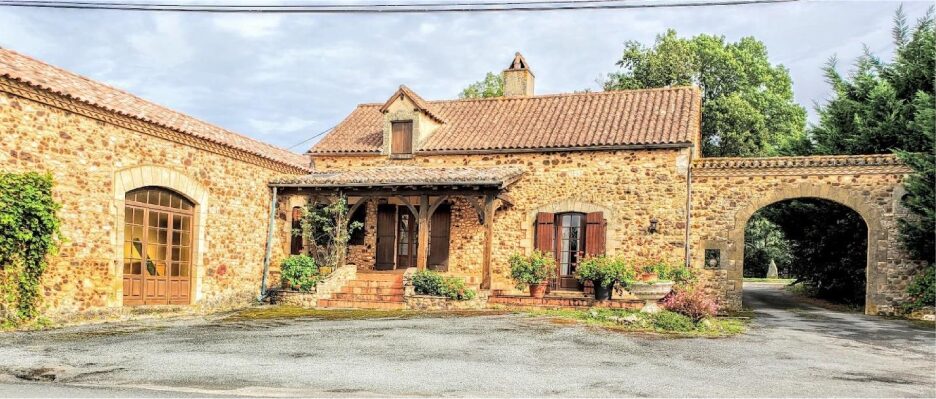
We’ve already discussed the prevalence of limestone. In the Dordogne the limestone is
honey-colored. All the buildings are made of it. As you drive down the road amid so
much green, honey-colored rock will peek out at you giving a vivid contrast to the
greenery. Dordogne is more cattle and farm country than vineyards. The limestone,
soft enough to have been sculpted by flowing waters, makes for unique, unusual rock
formations — much like the hoodoos of Utah. On our next trip here we must canoe or
kayak these rivers.

A farmhouse in the Dordogne
The Dordogne River boating is limited to canoes, kayaks and tour boats owned by a
company that is grandfathered in. The boat is an excellent way to view the countryside,
as you can see if you control/click the following:
Castles
There are many, usually perched on a promontory overlooking a town. Back in the
feudal days the lord of the chateau ruled the town and surrounding area with his “serfs”
doing his bidding. Of course things have changed. Many of the chateaux are now the
property of the town and open to tourists.
You’ve heard of Josephine Baker? She was an American singer/dancer in the ‘30’s
and 40’s who moved to Paris where she had great success. She bought a chateau in
the Dordogne, Chateau des Milandes, in Castlenaud. She was very popular in France,
and did well financially, for a while. Unable to bear children, she adopted 12 of various
nationalities. She also did important work as a spy during WWII. Using invisible ink
written on sheets of music, she transmitted enemy locations in North Africa. General
Charles de Gaulle awarded her the Legion d’Honneur, the highest honor in France. . In
August 2021 the remains of American-born singer and dancer Josephine Baker were
re-interred at the Panthéon Memorial in Paris, the only woman to receive this honor. Her
chateau is open for tours.

Castle where Richard the Lionhearted lived his final years
Food and Wine
Bergerac is one area of great wines. One of our literary heroes, Bruno, chief of police of
the fictitious town of St. Denis, by the author Martin Walker, introduced us to
Monbazillac, a superb white dessert wine. Another great white dessert wine in the
same area we discovered reading the book, “Grape Expectations”, by Caro Feely. We
visited the Chateau Feely winery in Saussignac and met Caro and her husband Sean.
They were in the middle of hand-picking their crop with the help of guests who come
every year because they love the process. Bear in mind that Caro’s book will make you
think twice, thrice, ten times about getting into the winery business. Yet, they’re still in
it. As the old saying goes: How do you make a small fortune? Start with a large one
and buy a winery.
The food. I’ve eaten so much duck that, I swear, I’ve developed a waddle. Duck confit,
magret, paté … so many ways to treat a dead duck. Not to mention the foods I never
eat at home: chicken gizzard, cuttlefish. Must be the fresh air, or the wine. Everything
goes well with the wine.
Lastly, the places we stayed. Our first place in Dordogne was Les Vitrolles. Located
in near Limeiul (another Beautiful Village of France), this is an ancient chateau. We
stayed in one of the out-buildings. It was end-of-season, so we were the only guests.
It’s amazing how much you miss modern conveniences when they’re not available. TV,
for instance. And Wi-Fi. We had to walk to the office and sit outside to be in Wi-Fi
range. And we had to rent the sheets!!
Les 2 Tours in Siorac. The owners, Vincent and Annick were wonderful. Our room was
tastefully decorated in Syrian cloths with all the necessities. Breakfast exceeded
expectations. Our computer broke. Vincent oversaw the repair. We left a whole bag of
stuff. Vincent sent it to us. As far as we’re concerned, they walk on water.

A much better breakfast than we ever served at our B&B!
A la Prochaine,
Chuck et Anzie
https://about-france.com/tourism/river-dordogne-area.htm
